“If we are to learn to improve the quality of the decisions we make, we need to accept the mysterious nature of our snap judgments.”
– from the book Blink (2005) by Malcolm Gladwell
As players and coaches, sometimes we don’t recognize what’s likely to happen on the baseball field until it actually does. It’s obviously not possible to foretell the future. But for those that can effectively anticipate probable outcomes during a game based on subtle observations and situational understanding, what is merely thought of as possible becomes probable which in turn becomes actual.
The game of baseball, more than other sports I believe, is filled with subtlety. Players do things in baseball games that go largely unnoticed by those not paying attention (and even those that are). A pitcher holds his glove at a different angle when he throws a fastball compared to when he throws a breaking pitch. A runner taking a lead off first stands slightly more erect hoping to make others think he’s not stealing when in fact he’s ready to run. A batter moves his hands up the bat handle ever so slightly because he’s getting ready to bunt.
Subtlety. Take notice.
Things happen in baseball games too that are suggestive of what’s to come. A batter goes down looking in the first inning on a fastball seemingly outside the strike zone low and away. A pitcher throws a ball-four curveball in the dirt. The opposing third-baseman continues to charge hard on a bunt even though the pitcher is about to make the play.
Each pitch, each swing, each at bat, each play, each inning, each game is filled with subtlety and information ready to be utilized to anticipate the future.
A batter goes down looking in the first inning on a fastball seemingly low and away suggests perhaps the ump is giving this part of the plate to the pitcher. As a hitter later in the game you better protect the outside corner when down in the count. As a pitcher you might want to work that spot all day long to your advantage.
A pitcher throws a ball-four curveball in the dirt means perhaps that pitcher won’t try that particular pitch again if behind in the count (he’s not likely to want to walk another batter).. As a hitter later in the game, get ready to tee off on a fastball. As the pitcher’s catcher, work location rather than worrying about the type of pitch in a similar future situation.
A third baseman that charges hard on a bunt (or fake bunt), leaves third base wide open for a runner on second to steal. Or better yet, leaves third base wide open for a runner on first to take second, then third on an actual bunt. Runners and coaches take notice.
Know that this isn’t about guessing what’s going to happen. And it’s not about over thinking or over analyzing situations. It’s simply about combining situational information with observational information from the moment and recognizing probable outcomes. Of everything that could happen in a particular situation, what do you think is likely to happen? Don’t guess, simply anticipate.
A few weeks ago our team played a couple scrimmages in Apple Valley. The first was against Lakeville North. And in the second inning of that scrimmage, with Ian on the mound and Charles in centerfield, an opposing right-handed batter fouled off two straight fastballs up and over the first base bench. The batter was getting under the ball (which made the ball pop up) and was swinging late (which made the ball go toward the right side of the field). I figured the batter wasn’t miraculously going to swing more quickly on subsequent pitches and I figured he very likely would continue swinging under the ball. Thus I told Charles to move to his left to better protect right center field. I’m guessing Charles didn’t fully hear everything I said as I yelled through the wind, but I told him the ball was going to be hit over his left shoulder and that he needed to be ready to make that play.
A couple pitches later the batter hit a high fly ball to right center field. Charles moved to his left and made the catch.
Could the outcome of the play have been different? Certainly. The possibilities in any given situation are virtually limitless. But what are the probable outcomes? What was likely to happen in that particular situation? I had figured one of four things was likely to happen. Either the batter was going to strike out, hit a hard line drive toward first, hit a relatively weak ground ball to second, or hit a high somewhat lazy fly ball to right center.
On July 14, 1946 in the opening game of a doubleheader at Fenway Park between the Boston Red Sox and Cleveland Indians, Ted Williams (in the midst of what would be an MVP season) went 4 for 5 with 3 home runs and eight RBI. In the second game, Cleveland manager Lou Boudreau, hoping to slow down the Splendid Splinter, employed what is now often referred to as the “Ted William’s Shift”. He stacked the right side of the field with most of his players.
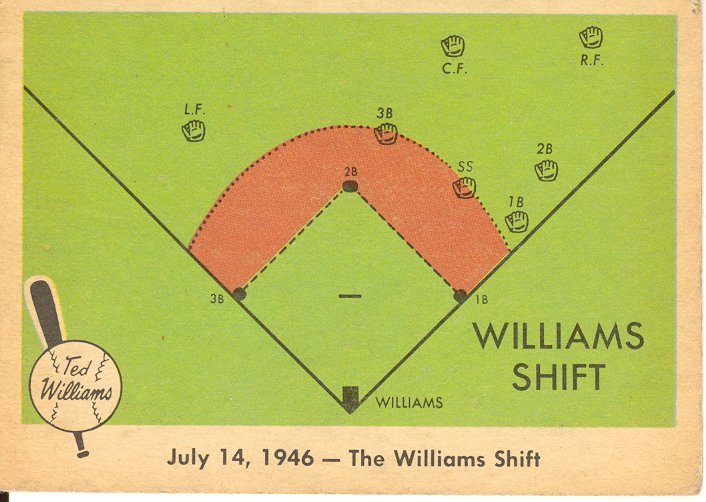
Why would a manager employ such an extreme strategy?
Because the probable outcome was that Ted Williams would hit the ball hard to the right side. Boudreau was simply anticipating what was likely to occur. (Williams by the way went 1 for 2 in that game with 2 walks).
Can you visualize the future and ready yourself for what is likely to happen?
Can you visualize the future and ready yourself for what you want to happen?
Imagine the possible then the probable to make the actual happen.


Discussion
Comments are closed.